
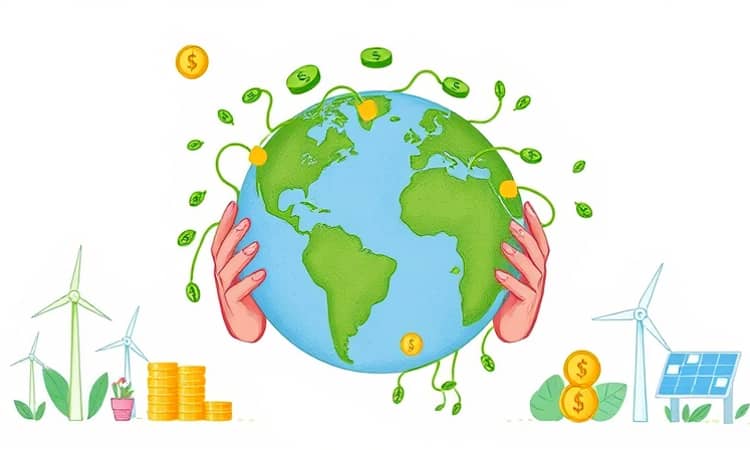
In a world where financial decisions can shape our planet's future, ethical investing emerges as a powerful tool for personal empowerment and global change.
Imagine aligning your portfolio with your values, turning every dollar into a vote for sustainability and social justice.
This movement is no longer niche; it's a rapidly growing force reshaping markets and inspiring hope for generations to come.
As you read on, discover how you can join this transformative journey and make your money matter.
The State of Sustainable Investing: Market Insights
Ethical investing has evolved from a moral choice to a mainstream financial strategy with substantial impact.
In the US, sustainable investments reached an impressive $6.6 trillion in recent years.
This represents about 11% of the total US market assets under management.
Globally, sustainable fund assets hit $3.7 trillion by the end of Q3 2025.
Despite some early outflows, driven by stock market gains, this sector continues to grow.
Investor confidence remains strong, with 86% of asset owners planning increased allocations in the next two years.
Younger generations are particularly enthusiastic, with 88% of global individual investors showing interest.
Key statistics highlight this momentum:
- US sustainable investments make up 11% of the total $61.7 trillion market AUM.
- Globally, ESG funds comprise 20% of the European fund universe versus only 1% in the US.
- 69% of US market AUM, or $42.7 trillion, is covered by active stewardship policies.
- 53% of US individuals anticipate sustainable market growth next year, though this is down from 73% in 2024.
These numbers underscore a shift toward long-term resilience and value creation.
What's Driving This Movement?
The rise of ethical investing is fueled by both environmental concerns and economic realities.
Top issues include climate change, which 52% of investors cite as a key driver.
Client customization and catastrophic climate events also play significant roles.
Emerging themes like AI are positively influencing decisions, with 23% noting its impact.
Investors are increasingly focusing on financial materiality, tying impact to cash flows and valuations.
This means ethical factors are seen as critical to risk assessment and returns.
Drivers from the context include:
- Climate change at 52%, client customization at 41%, and biodiversity loss at 34%.
- High-emissions sectors like energy see 86% investment, innovation at 76%, and transport at 72%.
- A shift from moral imperatives to practical outcomes that enhance corporate transparency.
This pragmatic approach helps balance short-term gains with long-term sustainability.
Strategies for Ethical Impact
There are multiple ways to engage in ethical investing, each offering unique benefits.
ESG integration is the most common, used by 77% of investors.
38% expect this strategy to grow in the next three years.
Impact investing has the strongest growth outlook, with 46% anticipating an increase.
In Europe, 58% of asset managers plan more impact allocations.
Sustainability-themed investing is also on the rise, with 43% expecting growth.
Stewardship, through proxy voting and engagement, is essential for driving value and resilience.
Key approaches include:
- ESG integration for mainstream adoption.
- Impact investing for measurable social and environmental outcomes.
- Thematic investing focused on areas like renewable energy or clean water.
- Active stewardship to hold companies accountable.
These strategies empower you to align investments with personal values effectively.
Trends Shaping 2026 and Beyond
Looking ahead, several trends will define the future of ethical investing.
Climate transition and decarbonization are top priorities, with a focus on Net Zero frameworks.
Renewables and energy transition infrastructure are driven by pure economics.
Sustainable bonds, including green and social bonds, have a market of over €3 trillion.
Biodiversity and nature solutions are gaining traction, with scalable outcomes like emissions avoided.
AI integration enhances impact measurement and risk assessment.
Regulatory evolution and regional dynamics, such as Europe's leadership, will shape global practices.
Major trends for 2026 include:
- Climate transition with Paris-Aligned ETFs rising.
- Renewables driving private climate investing surges.
- Sustainable bonds with examples like Ecuador's $1.6bn debt-for-nature swap.
- Biodiversity solutions in clean energy and agriculture.
- AI for better data insights and innovation.
- Physical climate risks receiving greater focus.
These trends highlight a move toward practical, results-driven investments.
Overcoming Challenges
Ethical investing faces political and market hurdles, but resilience prevails.
In the US, political pushback has moderated ESG but not caused a retreat.
Investors are recalibrating with a focus on materiality and growth narratives.
Geopolitical tensions and ESG backlash require demonstrating tangible value.
Credibility assessment through corporate engagement is crucial for trust.
Challenges include:
- US political dynamics affecting terminology and focus.
- Global shifts toward pragmatism in the face of backlash.
- The need for clear emissions targets and transition plans from companies.
By addressing these, investors can navigate uncertainties and stay committed to ethical goals.
How You Can Start Making a Difference
Beginning your ethical investing journey is simpler than you might think.
Start by educating yourself on sustainable options and assessing your risk tolerance.
Consider consulting with financial advisors who specialize in ESG or impact investing.
Diversify your portfolio with funds that prioritize environmental and social criteria.
Use tools like ESG ratings to evaluate companies based on their practices.
Engage in shareholder advocacy by voting on proxy issues related to sustainability.
Practical steps include:
- Researching sustainable mutual funds or ETFs.
- Setting clear investment goals aligned with your values.
- Monitoring performance through impact reports and data.
- Staying informed on regulatory changes and market trends.
- Joining investor networks focused on ethical causes.
This empowers you to contribute positively while aiming for financial returns.
Conclusion: Your Path to Purposeful Investing
Ethical investing is more than a trend; it's a strategic imperative for a better world.
By harnessing the power of your finances, you can drive positive change and secure a sustainable future.
Remember, every investment choice reflects your values and has the potential to shape tomorrow's legacy.
Stay optimistic, focus on data-driven solutions, and embrace the journey with resilience.
As industry leaders affirm, there is no retreat from this movement—only adaptation and growth.
Start today, and let your money make a difference that echoes for generations.